Showing posts with label Mise-en-scène. Show all posts

Saturday, 7 December 2013

Mise-en-scène Film Review: The Shining

The Shining is a 1980 British-American psychological horror film produced and directed by Stanley Kubrick, co-written with novelist Diane Johnson, and starring Jack Nicholson, Shelley Duvall, Danny Lloyd, and Scatman Crothers. The film is based on Stephen King's novel of the same name, though there are significant changes.

In the film, a writer, Jack Torrance, takes a job as an off-season caretaker at an isolated hotel. His young son possesses psychic abilities and is able to see things from the past and future, such as the ghosts who inhabit the hotel. Soon after settling in, the family is trapped in the hotel by a snowstorm, and Jack gradually becomes influenced by a supernatural presence; he descends into madness and attempts to murder his wife and son.

Fig.1 The Shining (1980)

This film creates an intensely claustrophobic atmosphere and a suffocating sense of personality disintegration despite the huge hotel in which they are staying in. The expert use of the camera and interior decor has been able to amplify the feeling of a prison to the audience.

The mix of long tracking shots and the musical score builds up a terrifying amount of dread. Especially when the camera is following young Danny on his tricycle along the corridors of the empty hotel. Lowering the camera to handlebar-level and exaggerating the sound of the wheels rolling across evenly-spaced rugs on a wooden floor. With it being drawn out for so long you just know something is going to happen. 

Fig. 2 The Shining (1980)

This is also apparent in the chase scene in the snow filled maze as the camera follows Danny try to escape from his father. It's an excellent tool used perfectly by a master film maker. James Berardinelli notes that; "By the end of the film, every inch of the hotel hints at something sinister and every frame is infused with a sense of the macabre." (Berardinelli, 2009)

The interior of the hotel is to be taken into account as well. Janet Maslin notes; "[The Shining] is so richly textured that it improves immeasurably upon second viewing, once an audience moves beyond worrying about a story line or taking the facts at face value." (Maslin, 1980). A strikingly powerful, and memorable, is the hexagonal carpet which Danny is sitting on, it looks like a maze, somewhat foreshadowing the events to happen at the end of the film, but it also represents the family being trapped within the hotel. 

 Fig.3 The Shining (1980)


Bibliography list:

Quotes:
Beraedinelli, James (2009) The Shining Film Review 
At: http://www.reelviews.net/php_review_template.php?identifier=1482 (Accessed on 30.11.13)
Maslin, Janet (1980) "Flaws Don't Dim 'The Shining'" 
At: http://www.nytimes.com/library/film/060880kubrick-shining.html (Accessed on 30.11.13)

Images:
Fig.1 The Shining (1980) [Poster] 
At: http://www.impawards.com/1980/shining_ver1.html (Accessed on 31.11.13)
Fig.2 The Shining (1980) Directed by: Stanley Kubrick, United States [Film Still] 
Fig.3 The Shining (1980) Directed by: Stanley Kubrick, United States [Film Still] 

Monday, 18 November 2013

Mise-en-scène Film Review: Black Narcissus

Black Narcissus is a 1947 film by the British writer-producer-director team of Michael Powell and Emeric Pressburger, based on the 1939 novel by Rumer Godden. It is a psychological drama about the emotional tensions within a convent of nuns in an isolated valley in the Himalayas. 

Fig.1 Black Narcissus 1947

The film was shot mostly on British studio sets and the backgrounds and vanishing perspectives were matte-paintings. The grandeur of the palace perched on the mountain side is still managed to look dwarfed in comparison to the snow-capped mountains. This came together beautifully in Technicolor. Thomas. M. Pryor, writing at the time of the film's release praises the excellent use of lighting to compliment the scenery; "...the whole chromatic scheme of the picture is marvellous to behold, and the russet hues of sunset streaking through the dilapidated Palace of Mopu, where once wine flowed and harem ladies cavorted, is a brilliant achievement in color composition." (Pryor, 1947)

Fig.2 Black Narcissus 1947

Not only was the lighting used particularly well for the scenery but also for symbolism. As the film progressed, a red tone will subtly filter in until it's become too late. We can see this happening with Sister Ruth in Fig.2. Keith Uhlich from Time Out describes the atmosphere created by the lighting; "You can fully sense the pervasive loneliness that entraps Sister Clodagh in distracting pangs of lost-love reminiscence, as well as the oppressive, sexually charged ambience that wreaks mental and metaphysical havoc on the frenzied Sister Ruth" (Uhlich, 2012)

Fig.3 Black Narcissus 1947

Review Bibliography:

Quotes:
Pryor, Thomas. M (1947) "The New York Times: Black Narcissus Film Review" 
At: http://www.nytimes.com/movie/review?res=EE05E7DF173CE261BC4C52DFBE66838C659EDE (Accessed on 16.11.13)
Uhlich, Keith (2012) "Time Out Says: Black Narcissus" 
At: http://www.timeout.com/us/film/black-narcissus-3 (Accessed on 16.11.13)

Illustration List:
Fig.1 Black Narcissus (1947) [Poster] 
At: http://www.imdb.com/media/rm1187756288/tt0039192?ref_=ttmi_mi_all_pos_18
(Accessed on 16.11.13)
Fig.2 Black Narcissus (1947) Directed by: Michael Powell and Emeric Pressburger, United Kingdom [Film Still]
Fig.3 Black Narcissus (1947) Directed by: Michael Powell and Emeric Pressburger, United Kingdom [Film Still]
At: http://videokrypt.wordpress.com/2012/05/07/black-narcissus-nuns-in-heat-in-glorious-technicolour (Accessed on 16.11.13)

Monday, 4 November 2013

Mise-en-scène Film Review: La Belle et la Bête

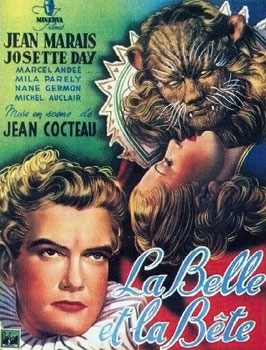
La Belle et la Bête is a 1946 French romantic fantasy film adaptation of the traditional fairy tale of the same name, written by Jeanne-Marie Le Prince de Beaumont and published in 1757, and directed by French poet and filmmaker Jean Cocteau.

The plot of Cocteau's film revolves around Belle's father who is sentenced to death for picking a rose from Beast's garden. Belle offers to go back to the Beast in her father's place. Beast falls in love with her and proposes marriage on a nightly basis which she refuses. Belle eventually becomes more drawn to Beast, who tests her by letting her return home to her family and telling her that if she doesn't return to him within a week, he will die of grief.

An interesting note to take, as mentioned by Michael Wilmington is that; "this film was made during the Nazi occupation under hard conditions -- at a time when French film artists more easily spoke their minds while hiding behind legends or tales of the past. And we feel the weight of oppression on the film." (Wilmington, 2002) With this in mind we can see the relatable oppression Belle suffered alongside the current events of their time. A story about escaping from a bad life.


Fig. 1 La Belle et la Bête (1946)

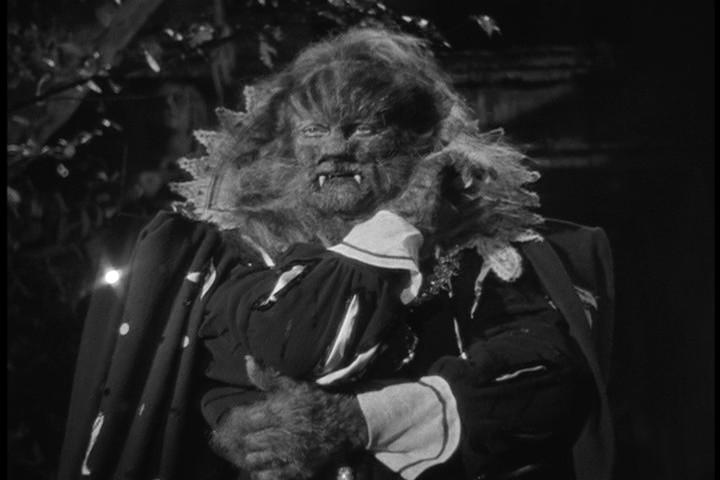
For its time, the set and costume design are truly beautiful and magical. First of all, Jean Marias who not only played the role of Belle's jealous suitor, Avenant, but also the Beast himself. What was truly remarkable about this, is that you honestly couldn't tell it was him. As we are a generation who rely heavily on CGI to transform people, this transformation for Marias, who was under layers of hair and make up, and forced to act with his limited expressions is a phenomenal achievement. As Tim Brayton addresses in his review; "I shall run the risk of hyperbole, and claim that the beast mask is the single greatest make-up effect of all time - if not necessarily the most strictly realistic, surely the most magnificent in effect, frightening us and seducing us in one breath, begging to be touched as much as anything in any film ever has been" (Brayton, 2008)

Fig. 2 La Belle et la Bête (1946)

The set designs too need to be applauded. The Beast's castle, filled with extravagant decors but still somewhat very simple, also had the enchanted touch to it. The one that stands out the most would have to be the floating arms holding candelabras that would stretch out as you walk down the hallway. As Sean. P. Means describes; "Cocteau didn't just interpret a fairy tale with this black-and-white wonder, but re-created a fairy-tale world. His Beast's castle is a shadowy place, where living human arms jut out from the walls to hold candles and open curtains. Candles light by themselves, and gorgeous strands of pearls appear as if by magic." (Means, 2007). Although a simple idea it gave the castle such an eerie atmosphere. Here, Cocteau is pushing the idea that sets do not need to be complex to be eye catching. The limited number of items in the sets in view allow the audience to focus on the special effects, the attention not being taken away by extravagant clutter.

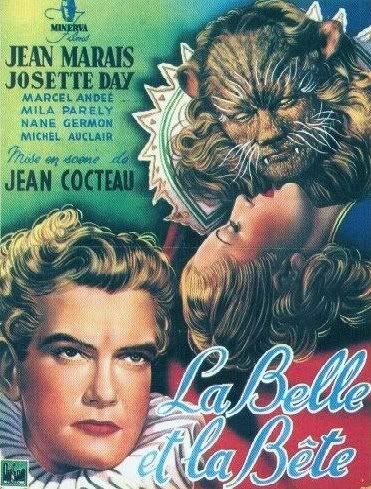
Fig. 3 La Belle et la Bête (1946)

Review Bibliography:

Quotes:
Brayton, Tim (2008) "TSPDT #190: La Belle et la Bete." At: http://antagonie.blogspot.co.uk/2008/06/tspdt-190-la-belle-et-la-bte.html (Accessed on 01.11.13)
Means, Sean P (2007) "Review: Cocteau's 'Beauty' still the best" At: http://www.sltrib.com/entertainment/ci_6086091 (Accessed on 01.11.13)
Wilmington, Michael (2002)  "Adults can fully appreciate the beauty of restored 'Beast'" At: http://articles.chicagotribune.com/2002-09-06/entertainment/0209060033_1_beast-josette-day-magical/2 (Accessed on 01.11.13)

Illustration list:
Fig.1 From: La Belle et la Bête. 1946 [Poster] 
Fig. 2 From: La Belle et la Bête 1946. Directed by: Jean Cocteau [Film Still], France 
Fig. 3 From: La Belle et la Bête 1946. Directed by: Jean Cocteau [Film Still], France